

The platform team publishes the golden path.
A Confluence page. A README. A wiki entry explaining the approved way to deploy a new service, provision a database, or configure observability.
Adoption is strong in the first two weeks. Engineers read it during onboarding. A few teams follow it on their next service.
Six months later, the platform team runs an audit. Half the services in production do not comply with the standard. Some never did. Engineers who read the doc once are deploying from memory. Teams under a deadline skipped the path entirely and built what they already knew.
The platform team calls it an adoption problem. It is not. It is a design problem.
The Business Case for Getting Golden Paths Right
Every decision an engineer makes without a golden path is a chance to deviate from the standard.
Manual decisions slow delivery. An engineer building a new Lambda function from scratch spends two hours figuring out the right IAM role scope, log retention policy, and error alerting configuration. A golden path that wraps this into a validated module turns that into a 15-minute task.
Manual decisions create inconsistency. Inconsistency compounds. Twelve teams deploying services twelve different ways means twelve different log formats, twelve different tagging conventions, and twelve different security postures to audit against.
Inconsistency produces three outcomes that appear on the platform team’s desk: incidents from configurations that deviated from a tested baseline, AWS cost anomalies from resource patterns that bypassed the approved cost controls, and audit findings from services that were never reviewed against the security standard.
The golden path does not eliminate these problems by existing. It eliminates them by being used.
Why Documentation Fails Under Pressure
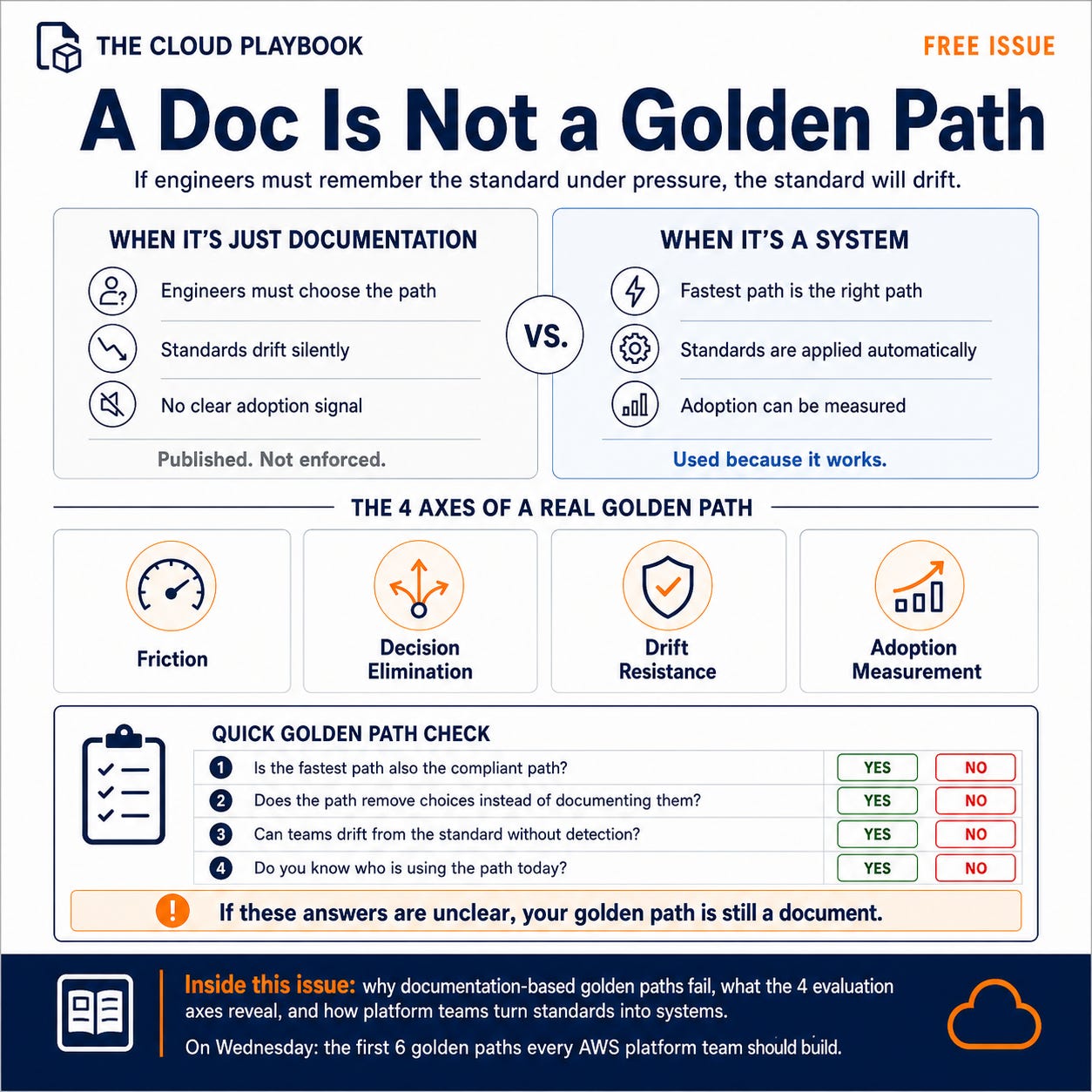
A Confluence page requires the engineer to do five things before the standard applies: know the page exists, find it, read it, remember the relevant parts, and choose to follow it when under deadline pressure with a closing release window.
That is five failure points. Under a deadline, discipline competes with speed. Speed wins.
Documentation-based golden paths suffer from three structural weaknesses that no amount of engineering culture can fix.
They require active adoption
The engineer must choose the golden path each time. In low-pressure conditions, most do. Under a production incident, a Friday release, or a late-quarter launch push, most don’t. The path that requires a decision is the path that gets bypassed.
They drift from the standard without detection
A Confluence page can describe the right pattern for provisioning a database. It cannot prevent an engineer from provisioning a different pattern. The documentation and the deployed state diverge silently. The platform team discovers the gap at the next audit.
They have no adoption signal
You cannot tell from a Confluence page how many teams followed it, which teams ignored it, or when the last adoption happened. Without a signal, the platform team cannot distinguish between “the path is working” and “the path was abandoned months ago.”
Four Axes for Evaluating Whether Your Golden Path Is a System
A golden path becomes a system when it reduces the cost of the right choice to below that of any alternative. Evaluate your existing golden paths against four dimensions:
Friction. Does using the golden path take less time than not using it? If the golden path requires more steps than the manual alternative, engineers will take the shorter route. A Terraform module that provisions a correctly configured RDS instance in five minutes beats a doc that explains how to configure one correctly in forty-five.
Decision elimination. Does the golden path remove choices, or does it document the right choice and leave the decision to the engineer? The distinction matters. A module that enforces the encryption setting eliminates the need for a decision. A doc that says “enable encryption” documents it. One applies the standard automatically. The other relies on the engineer remembering to do so.
Drift resistance. Can the golden path drift from the standard over time, or does it enforce the standard automatically? A Terraform module version-pinned to a tested configuration drifts when someone modifies it. A policy-enforced guardrail that rejects non-compliant resources does not drift. Drift resistance is a function of the enforcement mechanism, not documentation quality.
Adoption measurement. Do you know who is using the golden path, how often, and which services have adopted it? An internal module registry that tracks download counts, a pipeline template that logs invocations, or a tag applied automatically on module use all produce adoption signals. A Confluence page produces none.
A golden path that scores well across all four dimensions does not require marketing effort. It gets used because it is the lowest-friction option available.
What Platform Teams That Get This Right Actually Build
When golden paths are systems, three things change.
First, adoption is automatic. Engineers do not choose the golden path. They use it because it is the default, the fastest option, and the only path that meets compliance requirements without additional configuration.
Second, drift detection becomes operational. When services must pass through a validated module or pipeline template, deviations appear in the deployment log rather than in the audit. The platform team catches the gap before the auditor does.
Third, investment becomes measurable. Adoption metrics show which paths are in active use, which teams are using them, and what the alternative deployment time would have been. The platform team can quantify the hours saved, the incidents prevented, and the reduced audit exposure. That evidence changes the conversation with the CTO from “justify the platform investment” to “where should we build the next path.”
On Wednesday, paid subscribers get the first 6 golden paths every AWS platform team should build, including owner, implementation scope, adoption metric, and rollout sequence for each. The issue prioritizes paths by the combination of daily usage frequency, manual time cost, and compliance risk if skipped.
Upgrade If You Need Implementation, Not Just Ideas
If you’re using these emails to guide real decisions on your platform, you’ll get more leverage from the paid version of The Cloud Playbook.
The free newsletter gives you patterns and language.
The paid newsletter turns those patterns into implementation kits you can ship inside a quarter:
Concrete rollout plans (90‑day roadmaps for each pattern)
Templates and checklists (policies, runbooks, tagging schemes, review checklists)
Real examples from high‑stakes AWS environments (what we actually shipped and why)
If the paid side doesn’t save you more than the subscription in one incident, audit cycle, or bad migration you avoid, you should cancel and keep the playbooks.
That’s it for today!
Did you enjoy this newsletter issue?
Share with your friends, colleagues, and your favorite social media platform.
Until next week — Amrut
Get in touch
You can find me on LinkedIn or X.
If you would like to request a topic to read, please feel free to contact me directly via LinkedIn or X.