

Platform engineering leaders send monthly updates. Leadership reads them. Nothing changes.
The headcount conversation in the next planning cycle plays out the same way it did the previous quarter. The roadmap discussion still treats the platform as overhead. The budget conversation defaults to “do more with what you have.”
The problem is rarely effort. Most platform leaders write thorough updates.
The problem is the format. The update is structured around what the team did, not around what the business should care about. Leadership reads it, finds nothing they can act on, and moves on.
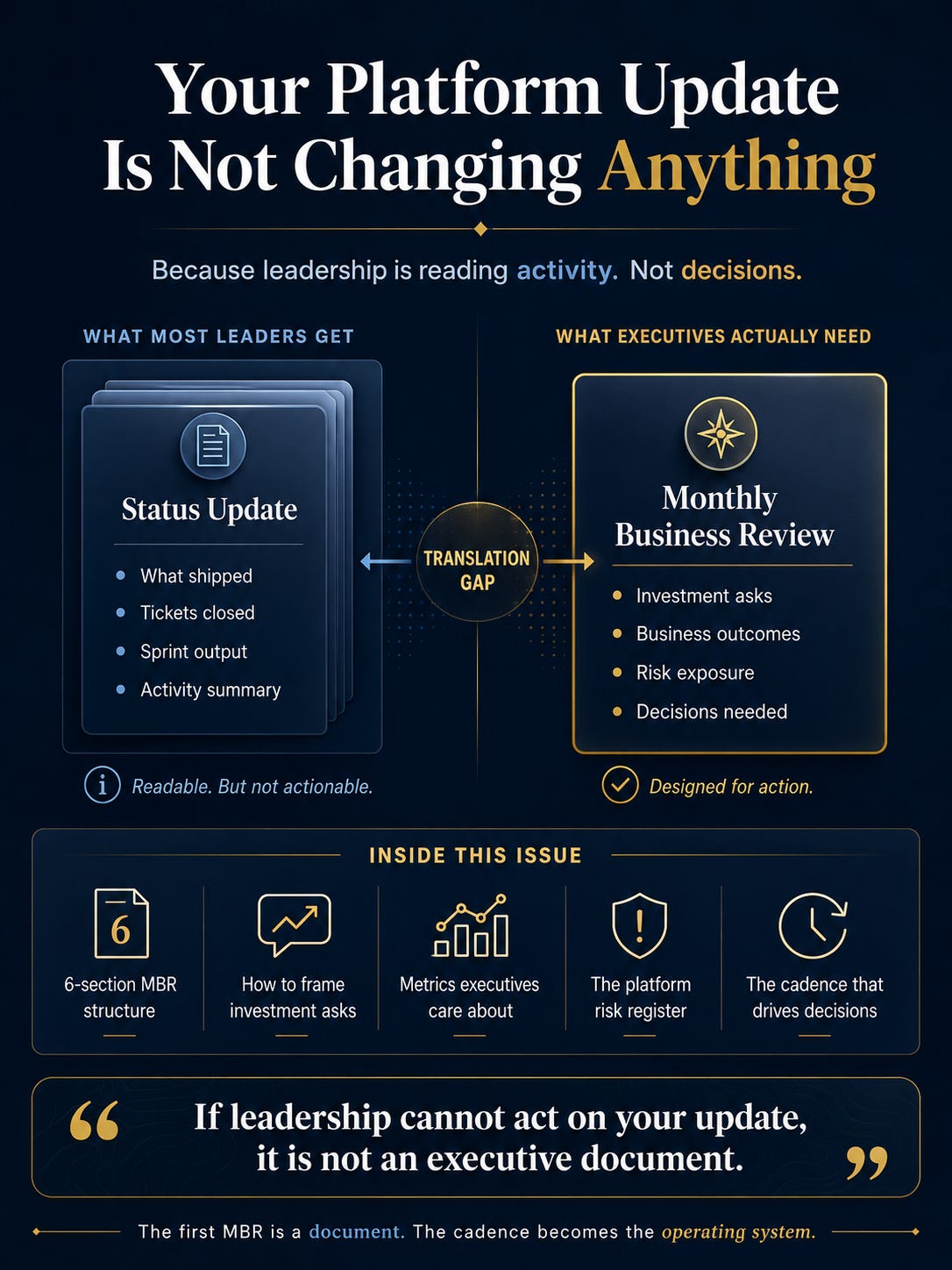
A Monthly Business Review designed for executive consumption fixes this. Not by inflating activity. By restructuring the same information so leadership can see the value, the risk, and the investment case in a format they already know how to read.
What an MBR Is and Is Not
A Monthly Business Review is a 4 to 6 page document delivered on a fixed cadence to a defined audience: VP of Engineering, CTO, and any executive whose budget the platform team draws from.
It is not a status update. Status updates report activity. MBRs report outcomes, decisions, and asks.
It is not a retrospective. Retrospectives are internal. MBRs are external-facing artifacts designed to inform investment decisions and surface risks that need leadership attention.
It is not a slide deck. The MBR is a written document that a CTO can read in 15 minutes without you in the room. If it requires you to walk leadership through it, the format is wrong.
The defining property of an MBR is asymmetry of effort. The platform leader spends three hours writing it. Leadership spends 15 minutes reading it. That trade is the format’s entire value.
The Six-Section Structure
Every MBR follows the same six sections in the same order. Consistency is the point.
Leadership learns the format once, then reads each subsequent MBR more quickly because they know where to look for what they need.
1. Headline and Investment Asks
2. Delivery and Velocity
3. Reliability and Operational Health
4. Cost and Financial Impact
5. Security, Compliance, and Risk
6. Next Month Priorities and Decisions Needed
Each section follows a sub-structure: outcome statement, supporting metrics, narrative context, and any decision the section requires from leadership.
Section 1: Headline and Investment Asks
The first 200 words of the MBR are the most important. If leadership stops reading after the first page, this section must contain the entire investment case.
The headline names the single most consequential outcome of the month in business terms. Not “we shipped the service mesh migration.” Instead: “MTTR for network-layer incidents dropped 60 percent following the service mesh migration, removing 3 hours of monthly engineer time previously spent on manual failover.”
Below the headline, three to five investment asks. Each ask is a single sentence stating the required decision, the timeframe, and the consequence of inaction. Examples:
“Approve the additional senior platform engineer in Q3 planning. Without this hire, the multi-account migration delivery date moves from October to January.”
“Authorize $80,000 in annual spend for the observability platform upgrade. Current tooling cannot ingest the volume the new compute fleet generates, creating monitoring gaps in production.”
“Confirm the platform team owns the compliance infrastructure boundary. Ambiguity in the boundary ownership is delaying audit evidence collection by an average of 9 days per finding.”
Each ask names the decision-maker implicitly: the VP, the CTO, the CFO. Leadership reads this section and knows exactly what is being asked of them.
Section 2: Delivery and Velocity
This section reports what the platform shipped in business terms, not infrastructure terms.
Lead with two metrics: number of teams accelerated by platform work this month, and engineering days returned to product feature work. Both numbers must be defensible. If you cannot show the math, do not include the number.
A defensible delivery report looks like this:
“This month, the platform team delivered the standardized RDS provisioning pattern, which 8 product teams adopted. Each adopting team eliminated an average of 2.5 days previously spent on database setup, configuration review, and secrets management. Total engineering days returned to product roadmap work: 20 days.”
Below the metrics, list the three to five delivery items that produced the impact. Keep each item to one line. Do not list every Terraform module or ticket. The leader reading this is interpolating from your numbers rather than auditing your sprint board.
Close the section with one paragraph on velocity trends: is the platform team delivering more, less, or the same volume of impact compared to the prior quarter, and what is driving the trend?
Section 3: Reliability and Operational Health
Reliability work is the most visible category of platform output but also the most prone to misreporting. The fix is to report both prevented and actual impact.
Lead with four metrics:
Production incidents this month, with severity breakdown
Mean time to recovery, with comparison to the trailing 90-day average
Incidents prevented through platform-level mitigations (with the specific control and the incident path it blocked)
Service availability against SLO, by tier
The number of prevented incidents is the most important. It is also the easiest to lose credibility if you overclaim. The discipline: only count an incident as prevented when there is a specific, named scenario that was caught in pre-production by a platform-owned control.
Example of a defensible prevented-incident entry: “On May 14, the IAM policy validator caught a privilege escalation path in a production deployment from the data-services team. Without the validator, the change would have granted s3:* on the customer-data bucket. Severity if shipped: P1.”
Close with a paragraph on the most consequential operational decision the team made this month, the reasoning, and the result.
Section 4: Cost and Financial Impact
Cost is the section that most directly translates platform work into language the CFO recognizes. Most platform leaders under-report here because the wins feel speculative. They are not. They are calculable.
Three metrics anchor this section:
Cloud spend this month vs prior month, with variance explanation
Cost optimizations realized this month, named individually with dollar impact
Forecast variance: Are you tracking to the annual cloud budget, and if not, what is driving the delta
A complete cost optimization entry contains four pieces: what changed, how much it saved, when the saving begins, and who owns the next iteration. Example:
“Right-sized the analytics tier RDS instances from r6g.4xlarge to r6g.2xlarge after observing sustained CPU under 30 percent. Annualized savings: $58,000. Effective May 12. Next iteration: review the data-platform Aurora cluster sizing in Q3.”
Close the section with one observation on the cost trajectory and one cost decision that requires leadership input. Cost decisions almost always require leadership input because they involve trade-offs between performance, redundancy, and price.
Section 5: Security, Compliance, and Risk
This section is where platform leaders systematically under-report and where leadership most often makes decisions on incomplete information.
Three categories belong here:
Security posture changes. Specific controls added, removed, or modified. New attack paths closed. Vulnerabilities remediated with severity and exposure window.
Compliance posture. Audit findings are open, in progress, and closed. Time-to-evidence by control. Compliance scope changes (new regions, new tenants, new frameworks).
Risk register changes. Risks newly identified, risks materialized, risks closed. Each risk in the register has an owner, a likelihood, an impact, and a status.
The risk register is the most undervalued artifact in the MBR. Leadership cannot manage risk they do not see. A platform team that maintains a written risk register and updates it monthly converts itself from a delivery function to a governance function in the eyes of executive leadership.
A risk register entry looks like this: “Multi-region failover for the auth service is untested at production load. Likelihood: Medium. Impact: High (customer-facing outage if east-region fails). Owner: Platform team. Status: Tabletop scheduled for June 18. Decision needed: Confirm 4-hour engineer commitment from the SRE team for the test.”
Section 6: Next Month Priorities and Decisions Needed
The final section closes the loop between this month’s results and next month’s commitments.
List the three to five priorities the platform team is committing to next month. Each priority states the outcome the team is targeting, the metric that will confirm success, and the date by which the work will be completed.
Below the priorities, list any decisions that leadership must make to enable the priorities. This is distinct from the investment asks at the top of the document. The questions at the top are organizational decisions about funding, headcount, and ownership. The decisions in this section are tactical: a specific approval, a specific resource, a specific stakeholder commitment.
Example: “To complete the SOC 2 evidence collection automation by June 28, the audit team must confirm the export format requirements by June 10. Without confirmation by June 10, the deliverable moves to July.”
This section makes the platform team’s dependencies on leadership explicit. It is also the section that most reliably produces follow-through, because leadership has already seen the math on what the dependency unblocks.
How to Run the MBR Cadence
The document is half the work. The cadence around the document is the other half.
Send the MBR three business days before the live review meeting. Leadership needs time to read, form questions, and check internal politics on any decisions you are asking for. A document delivered on the morning of the meeting forces leadership to react in the room, leading to worse decisions and eroding trust over time.
The live meeting is 30 minutes, not 60. The document serves to convey information. The meeting exists to make decisions. If the meeting becomes a presentation of the document, the document has failed.
Open the meeting with the investment asks, not the metrics. Leadership knows the metrics from the read-ahead. The meeting time is for resolving the asks. The first sentence in the room is “Section 1 lists three asks. Let’s start there.”
Capture decisions in writing during the meeting. Send the decision summary to the same distribution list within 24 hours. The decision summary is what creates the audit trail and the accountability loop.
Run this cadence for three consecutive months before evaluating whether the format is working.
The first MBR will feel awkward.
The second will feel mechanical.
The third will start producing the conversations that change how the leadership funds the platform.
What to Measure to Evaluate the MBR Itself
The MBR is a tool. Like any tool, it should be measured.
Time-to-decision on investment asks. Track the date each ask is submitted and the date the decision is made. A healthy MBR cadence resolves requests within 15 business days. Asks that sit longer indicate either incomplete framing or gaps in escalation.
Frequency of MBR-driven follow-up. Count the leadership questions, requests, or actions that originate from the MBR each month. A document that does not generate follow-up is being read but not acted on.
Headcount and budget conversation outcomes. Track planning cycles. The MBR’s actual goal is to change the conversation in the next planning cycle. Within two cycles, platform headcount and budget discussions should reference MBR data points by name.
If none of these signals improve in the first six months, the format needs adjustment. Most often, the issue is one of three things: the headline is not specific enough, the investment asks are framed as wishes rather than decisions, or the risk register is missing.
When the MBR Becomes the Platform’s Operating Document
The strongest signal that an MBR cadence is working is when leadership begins using it outside the meeting.
The CTO references the prior MBR in a board prep session.
The VP of Engineering pulls a metric from the MBR for a quarterly all-hands.
The CFO asks for the cost section formatted for a different audience. The MBR becomes the canonical record of what the platform team is, what it produces, and what it needs.
At that point, the document is no longer a reporting artifact. It is the operating document for the relationship between platform engineering and the rest of the executive team.
Upgrade If You Need Implementation, Not Just Ideas
If you’re using these emails to guide real decisions on your platform, you’ll get more leverage from the paid version of The Cloud Playbook.
The free newsletter gives you patterns and language.
The paid newsletter turns those patterns into implementation kits you can ship inside a quarter:
Concrete rollout plans (90‑day roadmaps for each pattern)
Templates and checklists (policies, runbooks, tagging schemes, review checklists)
Real examples from high‑stakes AWS environments (what we actually shipped and why)
If the paid side doesn’t save you more than the subscription in one incident, audit cycle, or bad migration you avoid, you should cancel and keep the playbooks.
That’s it for today!
Did you enjoy this newsletter issue?
Share with your friends, colleagues, and your favorite social media platform.
Until next week — Amrut
Get in touch
You can find me on LinkedIn or X.
If you would like to request a topic to read, please feel free to contact me directly via LinkedIn or X.