


You can also read my newsletters from the Substack mobile app and be notified when a new issue is available.

Speed is easy. Predictability is hard.
I learned this the expensive way.
Early in my career, I believed the job was to make things fast. Faster deploys. Faster provisioning. Faster everything. I optimized for velocity metrics because that’s what got applause in sprint demos.
It took three years of watching “fast” platform teams collapse under their own weight before I understood what I was actually seeing.
The teams that survived weren’t the fastest. They were the most predictable.
Their deployments weren’t always the quickest, but they rarely failed. Their infrastructure wasn’t cutting-edge, but everyone knew how it worked. Their documentation wasn’t exciting, but it was accurate.
The Lesson That Cost Me Three Years
I now lead a global platform team of 7 engineers across the US, India, and Colombia, managing 9 AWS accounts and supporting 75+ developers.
I’ve stopped chasing speed.
I chase knowability.
When a VP asks me when something will ship, I give a date. When an auditor asks for evidence, I run a query. When an incident happens at 2 AM, my team follows a playbook we’ve rehearsed, not a panic we improvise.
That’s what engineering predictability looks like in practice. Not bureaucracy. Not slowness. Just systems that behave the way you expect them to behave.
Thanks for reading The Cloud Playbook! Subscribe for free to receive new posts and support my work.
Why Fast Platform Teams Collapse
The pattern repeats across every company I’ve worked with:
A platform team ships fast. Leadership celebrates.
Six months later, the same team is underwater.
Incidents spike. Developers route around the platform. The CTO starts asking uncomfortable questions about ROI.
The failure isn’t technical. It’s organizational.
Fast teams skip the tedious work—ownership definitions, observability standards, and compliance automation—because it doesn’t demo well.
Then reality catches up.
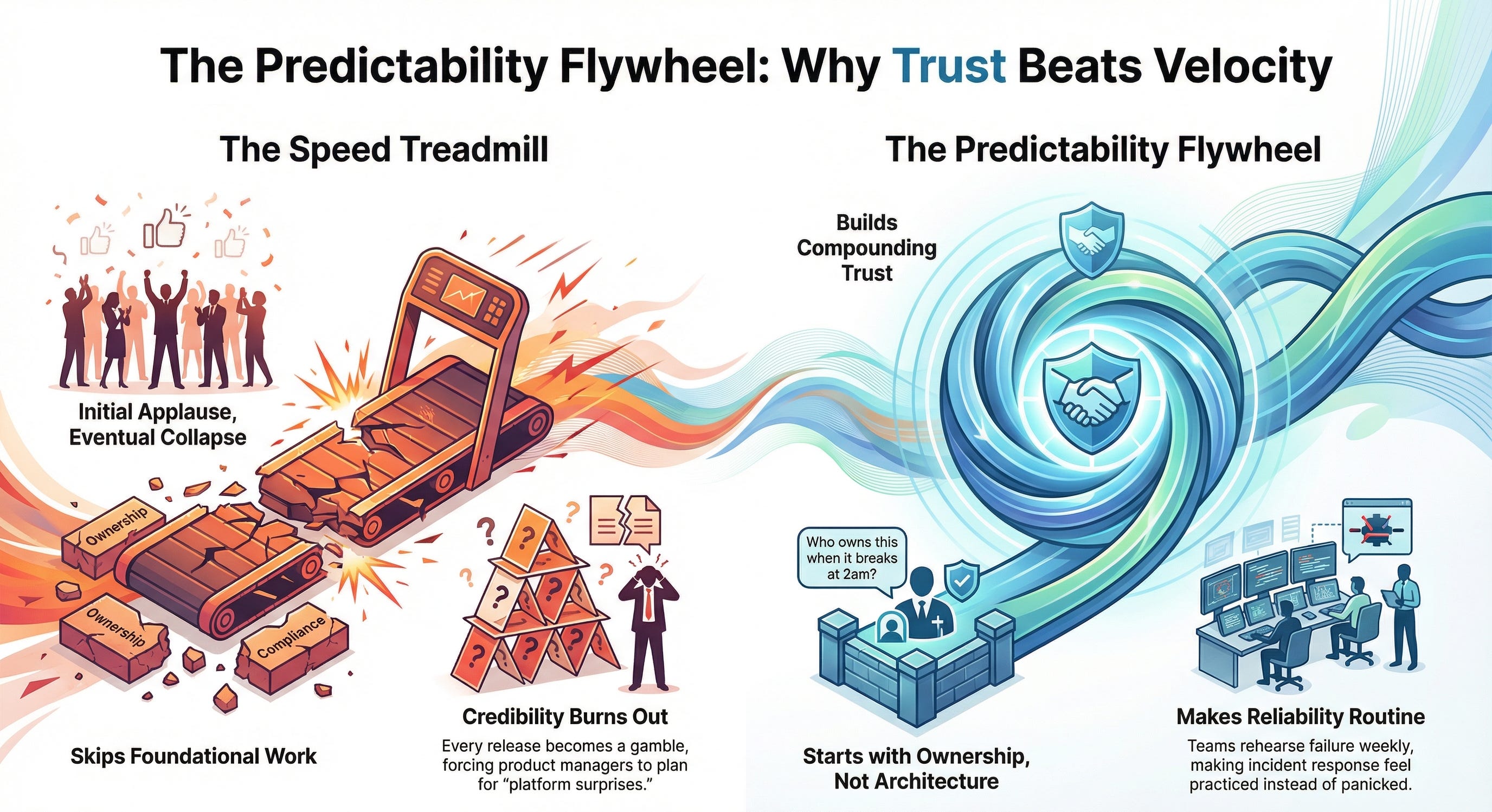
I watched one team reduce deploy times by 70% in their first quarter. By quarter three, they’d burned through their credibility. Every release was a gamble. Product managers started padding their timelines to account for “platform surprises.”
Meanwhile, a different team I advised took six months to ship their first significant improvement. But when they shipped it, it worked. And it kept working. By month twelve, product teams trusted them completely.
That developer trust compounded into influence, which compounded into budget, which compounded into impact.
Predictability is a flywheel. Speed without predictability is a treadmill.
How to Build Predictable Platform Teams
Here’s how I operationalize this:
Start with Ownership, Not Architecture
Every platform failure I’ve diagnosed stems from unclear boundaries.
Before you write a line of code, answer: Who owns this when it breaks at 2 AM?
If the answer is “it depends” or “we’ll figure it out,” you’re not ready to build.
Build Evidence as Exhaust
If you’re in a regulated industry, fintech, healthtech, or govtech, compliance isn’t optional.
But treating it as a separate workstream is how teams burn out.
Design your systems so evidence generation is automatic. Access logs, change records, and policy attestations are all captured as byproducts of normal operations.
Make Your SLOs Boring
The goal isn’t to hit 99.99% uptime once.
It’s to hit your target so consistently that nobody talks about it anymore.
When platform reliability becomes invisible, you’ve won.
Rehearse Failure Weekly
My team runs tabletop exercises for our top failure modes.
Not because we expect them to happen, but because when they do happen, the response should feel routine.
Predictable teams aren’t surprised by incidents. They’re surprised when incidents don’t follow the pattern.
The Bet I’ve Made With My Career
I’ve stopped trying to be the fastest platform engineering leader in the room.
I’m trying to be the most trusted one.
Executives don’t actually want speed. They want confidence. They want to walk into board meetings knowing the platform will perform as expected.
That’s the bet I’ve made with my career:
Predictability compounds. Speed without it doesn’t.
Speed is easy. Predictability is hard.
I build predictable platform teams that deliver both.
What’s your experience balancing speed and predictability?
Reply and let me know. I read every response.
Whenever you’re ready, there are 2 ways I can help you:
Free guides and helpful resources: https://thecloudplaybook.gumroad.com/
Get certified as an AWS AI Practitioner in 2026. Sign up today to elevate your cloud skills. (link)
That’s it for today!
Did you enjoy this newsletter issue?
Share with your friends, colleagues, and your favorite social media platform.
Until next week — Amrut
Get in touch
You can find me on LinkedIn or X.
If you would like to request a topic to read, please feel free to contact me directly via LinkedIn or X.

