

Requests pile up. Developers escalate to their managers, who escalate to platform leadership.
The SLA misses compound. Engineers work hard and still fall behind.
Every VP who sees this situation reaches the same conclusion: the platform team needs more headcount.
That conclusion is almost always wrong.
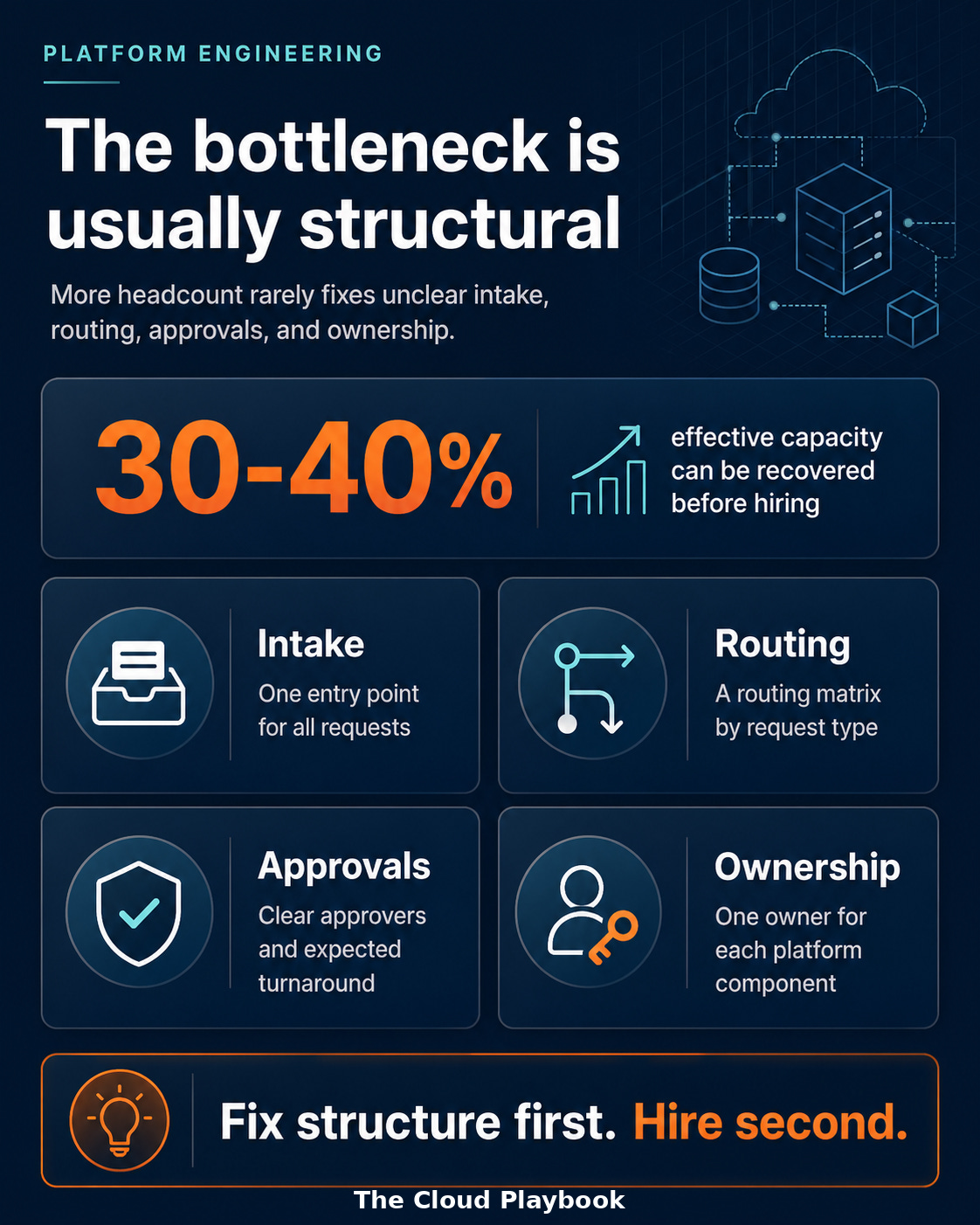
Platform team bottlenecks do not come from teams that are too small. They come from work that arrives through unclear intake channels, gets routed to ambiguous owners, and waits for undocumented approvals.
Why Faster Ticket Response Does Not Fix the Platform Engineering Bottleneck
The reflexive response to a growing platform team backlog is to optimize throughput.
Run intake meetings twice a week instead of once. Add a triage rotation. Write SLA targets. Bring in a TPM to route requests. Some leaders introduce a tiered priority system: P0 gets a 24-hour response, P1 gets a five-day response, and P2 gets a two-week response.
Each change makes the intake process marginally more efficient. None of them fixes what actually causes requests to stall.
They do not tell a developer where to submit a request when their Slack message from two weeks ago went unanswered. They do not clarify which approval an engineer needs to unblock a security exception. They do not identify who owns an ambiguous request when it lands in the queue with no routing context.
Adding a priority label to an unrouted request does not route it.
Faster throughput into an unclear structure is still unclear structure.
Four Structural Gaps That Make Platform Teams a Bottleneck
Platform engineering scalability problems follow a consistent pattern: four structural elements are usually missing at once.
Intake clarity. There is no single, well-defined path to request platform work. Some teams submit tickets. Others use Slack. Some skip both and corner a platform engineer directly.
Because the platform team intake process is informal, everything arrives marked urgent. The team cannot distinguish a genuine blocker from a request that can wait two weeks.
Routing clarity. Once a request lands, no one is certain who will handle it. The team is large enough that ownership is ambiguous.
Requests get forwarded, sit in limbo, or wait for whoever happens to know the most about that area. There is no platform team request routing logic written down anywhere.
Approval clarity. New infrastructure, security exceptions, and networking changes: each requires sign-off. But the approval chain is not documented.
Requests stall while engineers chase the right approver. Without a defined process, there is no predictable SLA for anything requiring sign-off, and every blocked request becomes a separate escalation path.
Ownership clarity. When something breaks or a decision needs to be made, “Who owns this?” takes too long to answer. If developer platform ownership is ambiguous during normal operations, it becomes a crisis under pressure. Every incident starts with a 20-minute conversation that should take 90 seconds.
These four gaps appear to be a capacity problem from the outside. Inside, they feel like everyone is working hard, but nothing is moving.
Adding engineers to this structure does not fix it. It replicates it. Each new hire spends their first months navigating the same ambiguity the current team has learned to live with.
The Four Questions That Confirm a Structure Problem
Before approving a headcount requisition, run this diagnostic.
If a developer needs a new service account today, do they know exactly where to submit the request? Or does the answer depend on who they know?
When a request arrives, can your platform engineer identify the owner in under five minutes without asking three colleagues?
For a security exception request, can you name the approver and the expected response time right now, without looking it up?
If you ask five engineers on your platform team, “Who owns the API gateway?” do you get the same answer within five minutes?
One “it depends” in those answers means you have a platform team structure problem, not a headcount problem. Hiring more engineers will not change those answers.
How to Make Platform Team Structure Explicit Before You Hire
These structural fixes cost less than a single hire and last longer than any retrospective.
Define one intake channel. One Slack channel. One ticket form. One entry point for all requests.
Not “it depends on the request type.” One place. This makes the queue visible and eliminates the parallel-path problem where the same work gets started twice by two people who each received a slightly different version of the request.
Build a routing matrix. For each request category, define who handles it by role, not name.
New service account: Platform Infrastructure team, reviewed Mondays. Security exception: Security guild plus Platform lead, SLA 5 business days. The matrix need not be complex. It needs to exist.
Document the approval chain. For every request type requiring sign-off, name the role and the expected turnaround. Post it in your intake channel.
Approvals do not need to be fast. They need to be predictable.
Assign single owners. Every platform component, every shared service, every critical decision needs one named person, not a team. Ownership rotates on a schedule. The clarity does not.
The goal is not to eliminate judgment from the platform team. It is to remove the structural overhead that consumes judgment before real work begins. When intake, routing, approvals, and ownership are clear, engineers spend more time engineering.
Run this check this week
Pull the last five platform requests that missed your SLA.
For each one, trace its entry into the system, its routing, who needed to approve it, and at which step it stopped moving.
That step is your structural gap. Fix it before opening a headcount requisition.
Teams that define intake, routing, and ownership before their next hire recover 30 to 40 percent of effective capacity without adding a single engineer. That is the capacity that the structural ambiguity was absorbing.
Every time I have traced a chronic platform team backlog to its root cause, the issue was structural: a missing routing matrix, an undocumented approval chain, and no one who could answer “who owns the API gateway” in under thirty seconds.
The team was not too small. The structure was invisible.
Upgrade If You Need Implementation, Not Just Ideas
If you’re using these emails to guide real decisions on your platform, you’ll get more leverage from the paid version of The Cloud Playbook.
The free newsletter gives you patterns and language.
The paid newsletter turns those patterns into implementation kits you can ship inside a quarter:
Concrete rollout plans (90‑day roadmaps for each pattern)
Templates and checklists (policies, runbooks, tagging schemes, review checklists)
Real examples from high‑stakes AWS environments (what we actually shipped and why)
If the paid side doesn’t save you more than the subscription in one incident, audit cycle, or bad migration you avoid, you should cancel and keep the playbooks.
That’s it for today!
Did you enjoy this newsletter issue?
Share with your friends, colleagues, and your favorite social media platform.
Until next week — Amrut
Get in touch
You can find me on LinkedIn or X.
If you would like to request a topic to read, please feel free to contact me directly via LinkedIn or X.