

You can also read my newsletters from the Substack mobile app and be notified when a new issue is available.
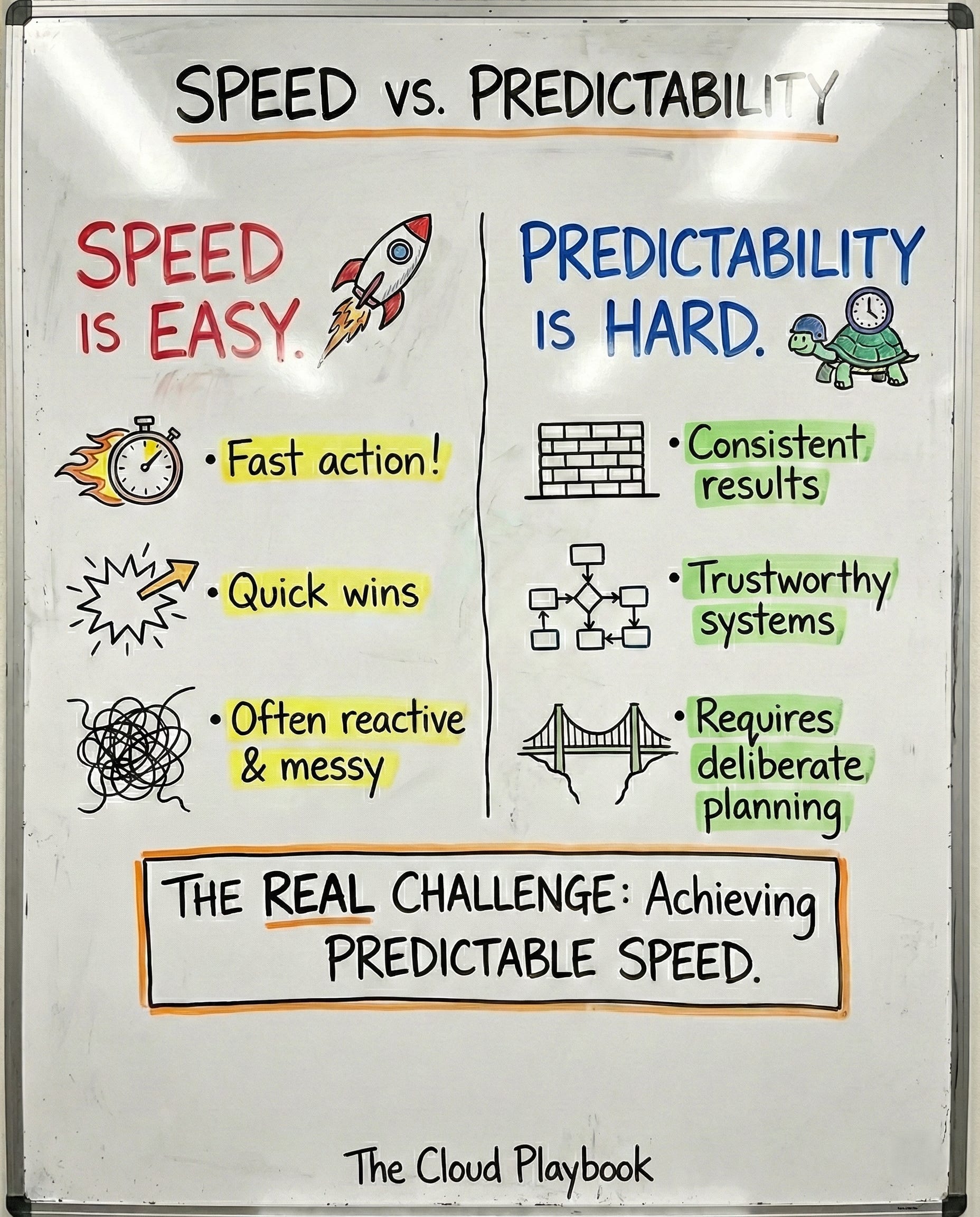
Speed is easy. Predictability is hard.
I built my platform engineering strategy around that distinction because predictable systems create sustainable speed.
Where did it come from?
Most engineering organizations prioritize speed metrics.
Deployment frequency. Lead time. Story throughput. Sprint velocity. Teams push for faster pipelines, faster reviews, faster shipping. The assumption is simple. Move faster, and outcomes improve.
But speed without predictability creates a different class of failure. One that rarely shows up on dashboards until leadership feels it.
Unexpected outages. Cost spikes without explanation. Compliance work that blocks releases at the worst time. Incidents where no one is certain who owns the fix. Deployments that technically succeed but introduce downstream instability.
Early in my platform leadership experience, I realized something uncomfortable.
Speed is the easiest capability to create in a modern cloud environment. Predictability is the hardest.
Any team can ship faster with enough pressure. Fewer checks. More autonomy. Fewer guardrails.
But the resulting system becomes harder to reason about with each release. Teams move quickly. Leadership loses confidence. Eventually, velocity slows because trust erodes.
This is the moment most platform strategies go wrong. They optimize for visible speed and ignore invisible predictability.
I built my platform strategy around the opposite assumption. Speed without predictability is fragile. Predictability creates durable velocity.
Why It Matters Now?
Cloud-native architecture made speed accessible.
Infrastructure can be provisioned in minutes. CI/CD pipelines can deploy continuously. Teams can spin up services without waiting on centralized operations. From a tooling perspective, the barriers to speed have largely disappeared.
Predictability did not become easier.
As organizations scale across teams, services, and environments, the number of possible failure paths multiplies.
Ownership becomes less obvious. Compliance requirements intersect with delivery timelines. Observability data increases, but clarity does not automatically follow.
Leadership does not worry about how fast teams can ship. Leadership worries about whether systems behave as expected after they ship.
Will costs remain within the forecast?
Will uptime remain stable?
Will audits pass without disruption?
Will incidents be contained quickly?
Will new tenants onboard without surprises?
Predictability is what allows executives to make commitments externally. Revenue targets. Customer SLAs. Regulatory timelines. Market launches.
Without predictable systems, every commitment carries hidden risk. Engineering becomes a source of uncertainty rather than leverage.
This is why I anchor platform strategy on predictability first. Speed becomes meaningful only when outcomes are consistent.
Predictability maps to delivery stability, not vibes
The industry already has language for this.
DORA frames delivery performance with velocity and stability signals. Change failure rate and time to restore service to capture instability. Deployment frequency and lead time capture speed.
Predictability occurs when speed improves without stability degrading.
What To Do With It?
Design the platform to reduce variance, not just increase throughput.
1) Make releases boring through standard paths
If every team deploys differently, outcomes will vary. Predictability drops.
Use golden paths as the default route for common workflows.
Golden paths are designed to reduce cognitive load and help teams operate safely and consistently.
Internal developer platforms are commonly described as tools that glue together golden paths, reducing cognitive load and enabling self-service.
When you reduce cognitive load, you reduce variance. When you reduce variance, you get predictability.
2) Invest in rollback confidence before you chase faster deploys
Fast deployments only matter if rollback is trivial and well understood.
Standardize deployment patterns. Standardize rollback patterns. Encode ownership. Instrument the deploy so you can tell within minutes whether the release behaved as expected.
If leaders cannot trust release outcomes, they will eventually slow you down. That is predictable too.
3) Treat reliability as a control system with error budgets
Predictability is not the absence of failure. It is a controlled failure within known limits.
Error budgets are an SRE mechanism for balancing reliability and the pace of change. When error budgets are consumed, attention shifts from feature work to stability work.
This is a platform design pattern, not an SRE process detail. If the platform cannot enforce the tradeoff, teams will negotiate it during incidents. That increases organizational load.
4) Design compliance and cost as defaults, not after-the-fact work
If audits require manual evidence gathering, the system is not predictable. If cost spikes require detective work, the system is not predictable.
Predictability comes from defaults and guardrails that make the right behavior the easy behavior.
Logging, access controls, and change management should produce proof by default. Self-service should provision compliant, observable, and cost-tagged infrastructure by default.
How To Measure Predictability?
Do not measure predictability as a feeling. Measure it as variance reduction.
Use DORA stability signals as leading indicators. Change failure rate. Time to restore service.
Then add platform-specific questions that expose surprise.
How often do incidents surprise the team?
How often do cost spikes require investigation?
How often do releases behave differently than expected?
How often does ownership confusion delay resolution?
These are operational proxies for predictability. They tell you whether the platform is creating confidence or creating work.
Speed is easy. Predictability is hard. I build platforms that deliver both.
Whenever you’re ready, there are 2 ways I can help you:
Free guides and helpful resources: https://thecloudplaybook.gumroad.com/
Get certified as an AWS AI Practitioner in 2026. Sign up today to elevate your cloud skills. (link)
That’s it for today!
Did you enjoy this newsletter issue?
Share with your friends, colleagues, and your favorite social media platform.
Until next week — Amrut
Get in touch
You can find me on LinkedIn or X.
If you would like to request a topic to read, please feel free to contact me directly via LinkedIn or X.